


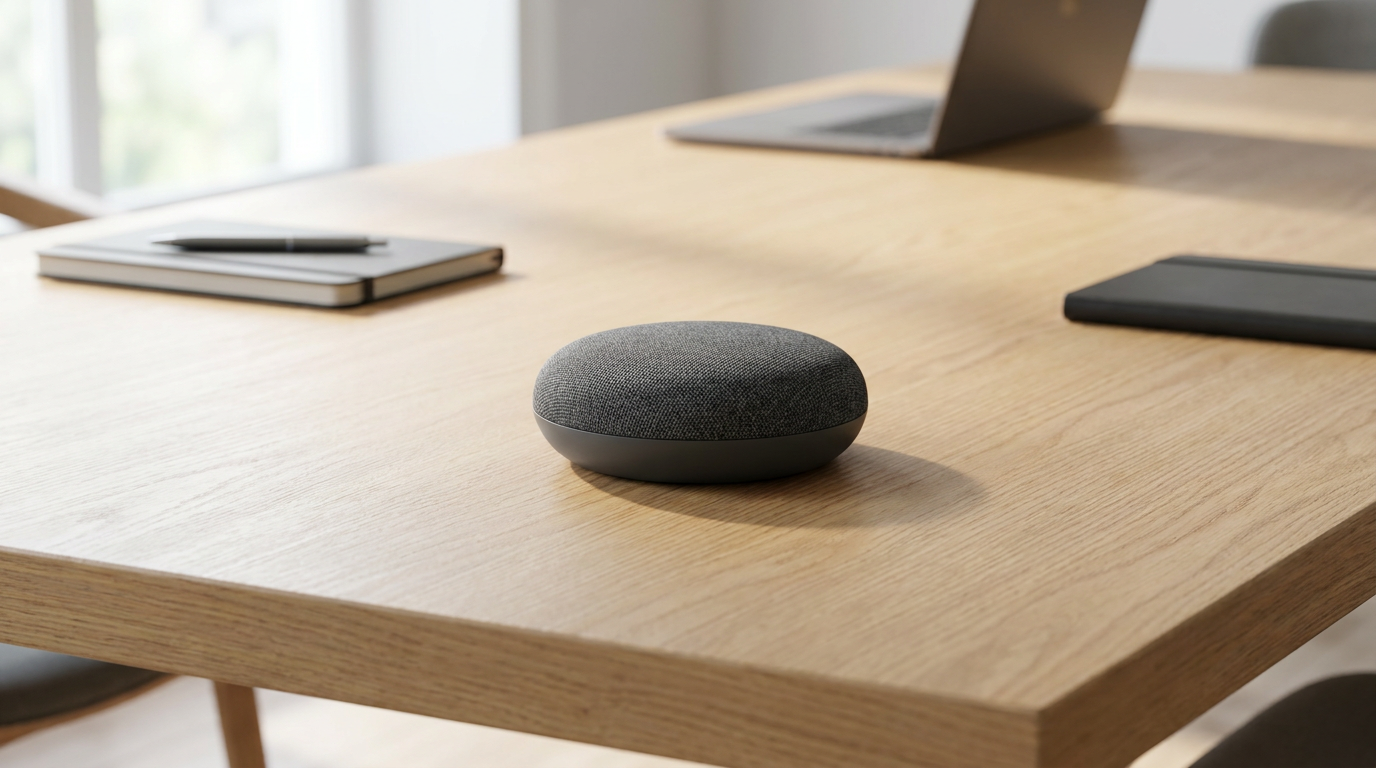
A bluetooth speaker with microphone earns its place on a meeting table by how far its mics reach and how cleanly it cancels echo, not by how loud it plays music. The three units below publish those call figures, so you can compare them before you buy.
Pickup range decides the room, not volume
Manufacturers state pickup range as the distance at which the microphone array still captures a voice at normal speaking level. The Jabra Speak2 75 lists up to 2.5 m (8.2 ft) and a rated room size of 4.5 by 4.5 m. The Poly Sync 20 lists 2 m (7 ft) and a 3 by 3 m room.
Half a metre sounds trivial. Seat four people around a 1.8 m table and someone leaning back already sits near a 2 m unit’s limit.

Video: Headset Advisor
Call bandwidth is not music bandwidth
All three units play music from 80 or 100 Hz up to 20 kHz. On a call the path narrows to what the mics and the codec carry. The Speak2 55 and the Sync 20 cap the microphone near 7 kHz, which is standard wideband voice. The Speak2 75 reaches 14 kHz, which Jabra calls super-wideband.
The extra bandwidth carries the consonants that separate fifteen from fifty. The far end only hears them if the call platform supports the wider band.
| Model | Microphones | Mic pickup range | Rated room size | Mic bandwidth on calls | Speaker | Talk time | Bluetooth |
|---|---|---|---|---|---|---|---|
| Jabra Speak2 75 | 4 beamforming MEMS | Up to 2.5 m (8.2 ft) | Up to 4.5 x 4.5 m | 150 Hz to 14 kHz | 65 mm, 88 dB SPL at 0.5 m | Up to 32 hours | 5.2 |
| Jabra Speak2 55 | 4 beamforming MEMS | Up to 2.3 m (7.55 ft) | Up to 4.5 x 4.5 m | 150 Hz to 7 kHz | 50 mm, 85 dB SPL at 0.5 m | Up to 12 hours | 5.1 |
| Poly Sync 20 | 3-microphone array | Up to 2 m (7 ft) | Up to 3 x 3 m | 100 Hz to 7.8 kHz | 40 mm | Up to 20 hours | 5.1 |
Manufacturer figures from the Jabra Speak2 75 and Speak2 55 technical specification sheets and the HP Poly Sync 20 datasheet, September 2026.
Echo, duplex and the reason units go back
Echo happens when the speaker output leaks into the microphones and travels back to the other side. Acoustic echo cancellation (AEC) subtracts that leak digitally. All three units list AEC and full duplex, meaning both ends can talk at once without the unit muting one of them.
A spec sheet cannot tell you how well AEC copes with your room. Hard tables, glass walls and a unit wedged against a laptop all raise the leak. Centre it on the table with clear space around it before you judge the microphones.
Check the connection path too. Jabra lists Bluetooth on the Speak2 units for smartphones and tablets only; a laptop uses the built-in USB cable or, on some variants, a Link 380 adapter. Poly lists Bluetooth for smartphones and USB-A for computers on the Sync 20.
When a speakerphone is the wrong tool
If one person needs the clarity rather than the whole table, over-ear headphones put their mics far closer to your mouth than any tabletop array. Our AirPods Max 2 review covers what changed in the current generation.
Speakerphones travel in a pouch and headphones in a case. Our roundup of AirPods Max case options helps you settle on one bag for both.
In a meeting room with a wall-mounted TV, the speakerphone handles voices only. Video playback belongs to a soundbar, and our TV soundbar mount guide covers fixing one to the screen.
Which unit fits which table
Solo desk or two people on a call: the Sync 20 range and 20-hour talk time cover it. Four to six people in hybrid meetings most days: the Speak2 75 with its 2.5 m reach and 14 kHz mic path is the one to pay for.
The Speak2 55 sits between them. You get the same four-mic array as the 75, but with wideband voice and a 12-hour battery, by manufacturer figures.

